

Quarterly brand reviews are good at revenue, pipeline, and campaign metrics. They are still bad at answering a newer question: what changed in how answer engines mention us?
The brands that win the next year of AI search will not be those with the flashiest one-off audits—they will be those with the most boring, relentless quarterly discipline.
This article is a template for that review—the kind of pattern read WorldBrand encourages teams to run on top of AEO Intelligence snapshots. Fill it with your numbers; keep the questions even if the charts move.
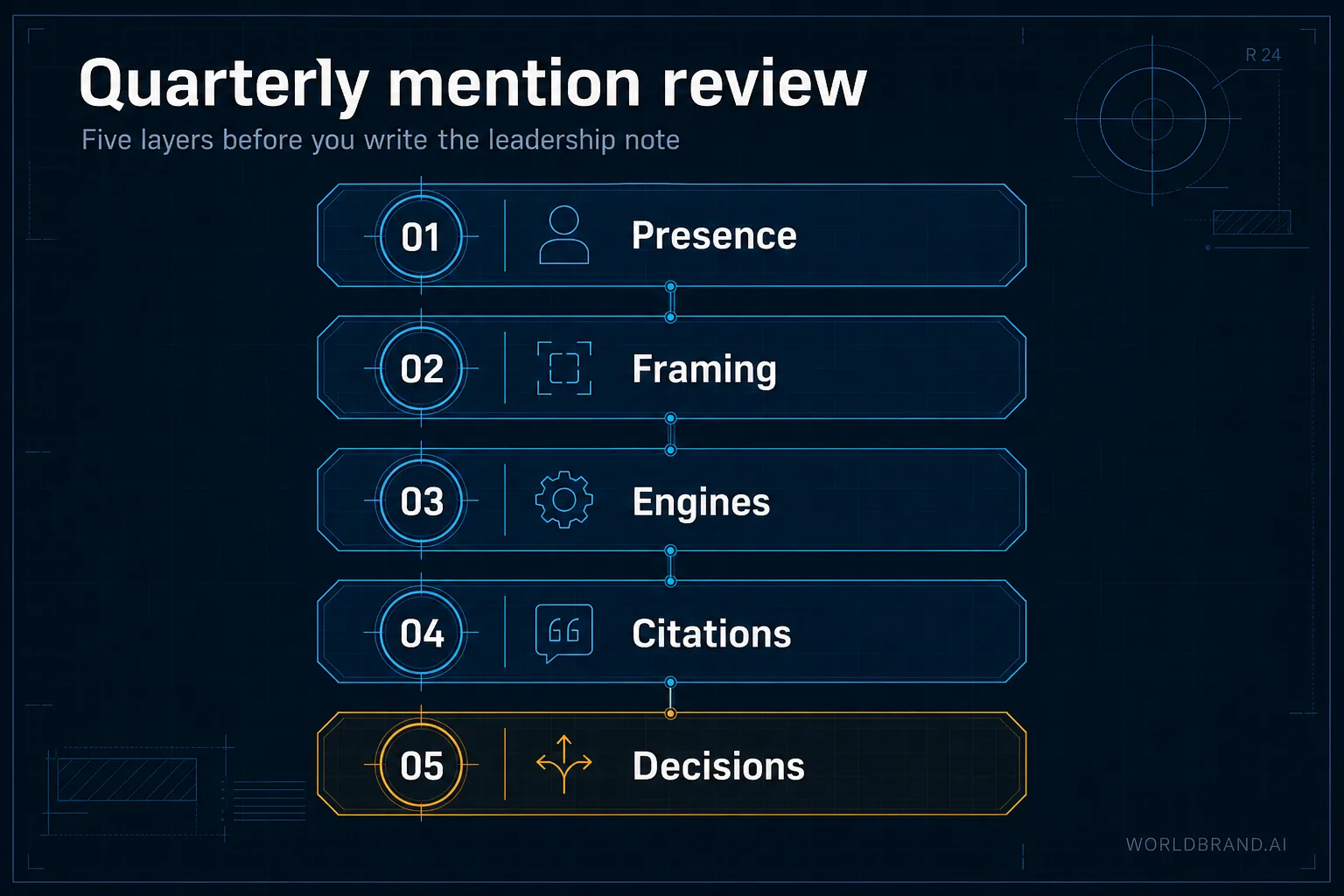
1. Presence: did we enter or exit shortlists?
Look at unbranded category and best-of prompts:
- Mention rate vs last quarter
- Share of voice vs named peers
- Prompts where we newly appear / newly disappear
Interpret carefully. A two-point move on a tiny set is noise. A ten-point move concentrated in one prompt tag (e.g., mid-market segment) is a story.
2. Framing: did adjectives shift?
Presence without framing is incomplete. Track recurring descriptors:
- Price ("premium," "expensive," "affordable")
- Complexity ("enterprise," "simple," "legacy")
- Trust ("established," "innovative," "risky")
If mention rate is flat but framing worsened, you did not "hold steady." You lost narrative ground. Measure framing with a codebook—see How to Measure Sentiment in AI Answers.
3. Engine disagreement: where do models split?
Cross-engine divergence is a first-class signal:
- Engine A cites docs; Engine B cites a stale roundup
- Engine C includes you; Engine D prefers a specialist peer
- Sentiment polarity flips by model family
Disagreement often points to evidence fragmentation, not random mood. Assign owners to the sources that drive the worst engine. For a lab-style read on divergence, see Engine Disagreement on Category Prompts.
4. Citation churn: which domains gained power?
List top citation domains this quarter vs last:
- New entrants (new review cluster, new affiliate network, new news spike)
- Dropouts (deprecated docs, removed pages, lost PR)
- Concentration risk (one domain > disproportionate share)
Citation churn is where AEO meets web ops and PR. Brand Wiki helps you inspect brand context while you chase the URL-level story; Brand Wiki-style hygiene matters when encyclopedic pages are in the mix.
5. Category weather: what moved the whole field?
Separate brand-specific movement from category weather:
- Peer launches or pricing resets
- Regulation or safety narratives
- Seasonality in buyer questions
- Visible model / product updates in consumer AI apps
If everyone lost SOV on a prompt family, you may need set redesign—not a brand crisis war room.
6. Structural link-back: does brand structure explain the gap?
Once a quarter, overlay AI visibility with Brand Wiki shape and brand equity trend:
- Globalization gaps → weak regional prompt performance
- Momentum spikes → temporary SOV without stability
- Leadership strength → still absent on unbranded prompts (evidence problem)
This prevents AEO from becoming an orphan channel with orphan budgets.
7. Decisions only (the only slide that matters)
End with five lines max:
- Keep measuring (prompt set version + peers)
- Repair (top three evidence tickets)
- Create (one citeable asset)
- Earn (one corroboration bet)
- Stop (one vanity activity)
FAQ
Who should own the quarterly AI mention review?
The AEO lead or brand ops DRI runs the fixed agenda, locks numbers before the leadership readout, and refuses to end without the five-line decision slide. Marketing leadership receives the note; they do not substitute for an operating owner who creates tickets.
What is the anti-pattern in quarterly AEO readouts?
Rewriting prompt wording mid-quarter to manufacture a win, or presenting one friendly engine screenshot as "progress." Both destroy trend integrity and turn category intelligence into social-listening cosplay.
How do we attach this to planning we already run?
Steal 60 minutes from an existing quarterly ops or brand ritual—same locked prompt set and peer set as weekly scoreboards—and end with posture, tickets, and prompt-set version ID. Wire repairs into the weekly rhythm from From Snapshot to Operating Rhythm.
What should leadership receive—not just see?
A short note naming bets to keep, stop, or start, plus fact owners for citation and framing repairs. Charts without owners and due dates are a review, not a decision.
Where WorldBrand.ai supports the ritual
- AEO Intelligence — visibility, narrative, sources, and competitive presence on locked prompts
- Brand Wiki — structured brand profiles and the public facts models can cite
- World Model — explore how a brand decision could unfold (coming soon)