
AI visibility snapshots show where you stand; operating rhythms change where you stand. Measurement becomes advantage only when it enters a repeating cadence with owners, decisions, and repairs—not another slide.
The graveyard of AEO programs is full of beautiful first snapshots.
Someone ran prompts. Someone built a slide. Someone said "we should monitor this." Nobody owned the Tuesday after.
AEO Intelligence can show mention rates, sentiment, authority, and citations across answer engines. That is necessary. It is not sufficient.
Why do AEO snapshots stall?
Snapshots fail for the same reasons pilot labs fail:
- Measurement without a DRI (directly responsible individual)
- Insights without a ticket (nothing enters backlog)
- Vanity prompts that never threaten revenue narratives
- No SLA for fixing the public evidence models actually cite
- Leadership review that rewards activity ("we checked") over outcomes ("SOV on unbranded category prompts rose")
If your only ritual is opening the dashboard when anxious, you do not have a program.
What does a weekly AEO rhythm look like?
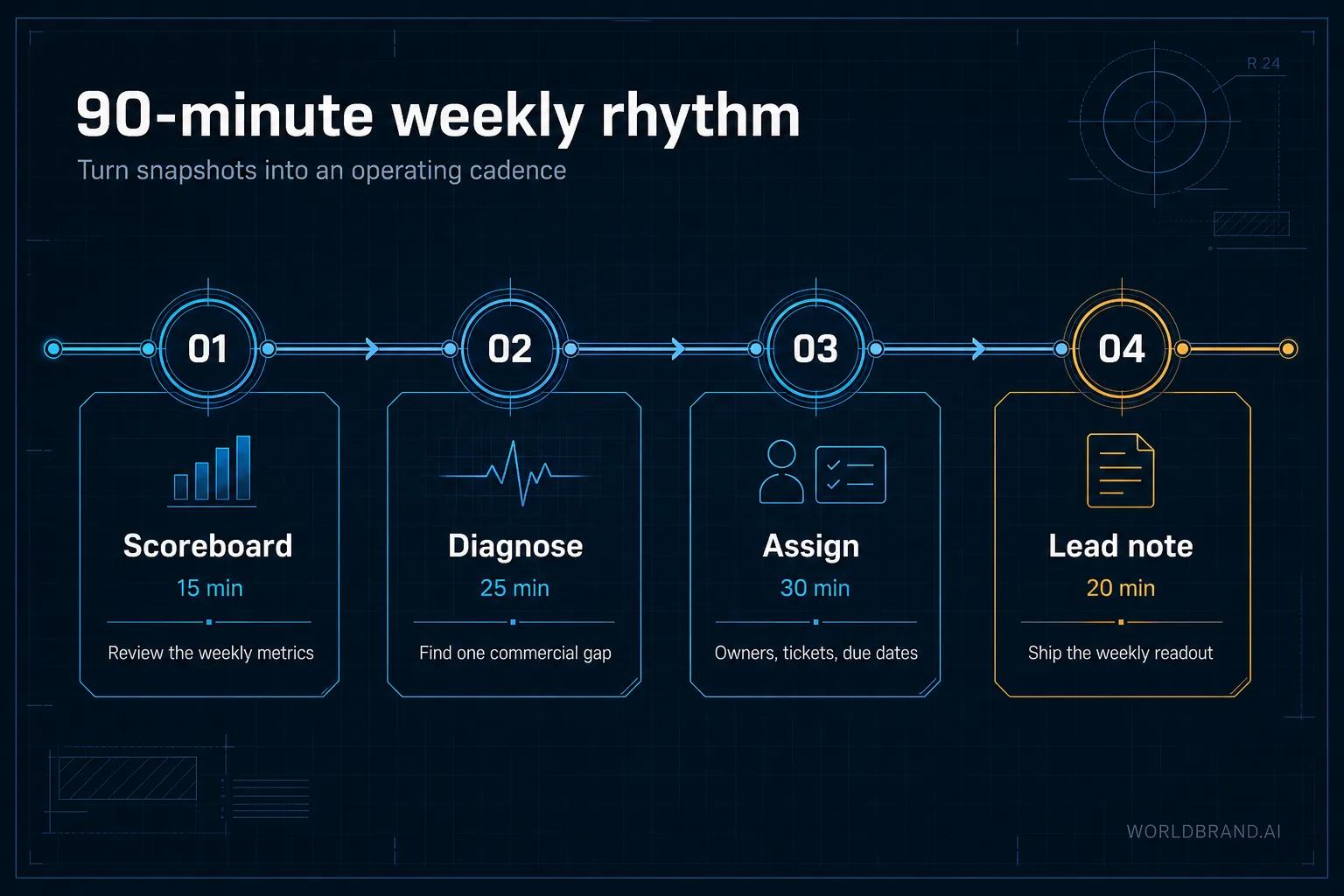
1. Scoreboard (15 min)
Review the locked prompt set:
- Mention rate and share of voice vs peers
- Sentiment / framing shifts
- Engine disagreements worth investigating
- Citation domain concentration
Use the same definitions every week. If you change the prompt set, version it and annotate the chart.
2. Diagnose (25 min)
Pick one movement that matters commercially. Ask:
- Did we lose presence, framing, or citations?
- Is the cause owned (site/docs), earned (PR/reviews), or environmental (peer launch, model update)?
- What would falsify our hypothesis?
3. Assign repairs (30 min)
Translate diagnosis into work:
| Queue | Examples | Owner archetypes |
|---|---|---|
| Facts & docs | Specs, pricing language, category nouns | Product marketing / web |
| Encyclopedic / reference | Wikipedia-class clarity, timelines | Comms / brand ops (Brand Wiki) |
| Earned corroboration | Analyst notes, credible roundups | PR / partnerships |
| Measurement | Prompt tags, peer list, region coverage | AEO lead |
Every item needs: owner, due date, success signal (e.g., "citation to stale review drops on prompt cluster X").
4. Leadership note (20 min)
Send a short note—not a novel:
- What moved
- What we are doing
- What we need (budget, legal, product decision)
- What we are not doing this week
What should monthly and quarterly layers include?
| Cadence | Focus |
|---|---|
| Monthly | Peer-set review, prompt-set hygiene, campaign correlation check (did a launch show up in answers?) |
| Quarterly | Strategy reset—tie AEO outcomes to Brand Wiki narratives, structural gaps, and brand equity trajectory. Decide whether the peer set still matches how buyers shortlist. |
Which SLAs keep the machine honest?
Suggested starting SLAs (adjust to your org):
- P0 factual conflict on a cited URL: acknowledge in 2 business days, publish correction path in 10
- New unbranded category gap vs primary peer: hypothesis + owner within one weekly cycle
- Prompt-set change: require written rationale; never silent edits
- Dashboard red without ticket: treat as process failure, not just brand failure
FAQ
Who should own the weekly AEO meeting?
Name a DRI—usually brand ops or an AEO lead—who runs the scoreboard, forces one diagnosis, and refuses to end without tickets. Marketing leadership attends the last block (or reads the note); they do not substitute for an operating owner.
How do we attach this to a meeting we already have?
Do not create a floating “AEO council.” Steal 90 minutes from an existing Tuesday ops or growth ritual, put the locked prompt scoreboard first on the agenda, and cap WIP so the hour produces repairs—not another readout.
How much work should stay open at once?
Cap evidence-repair WIP hard (many teams start at 3–5 active items). A red dashboard with no ticket is a process failure; an endless backlog with no ship date is the same failure in slow motion.
What if leadership only wants slides?
Send the leadership note anyway: what moved, what ships, what you need, and what you are not doing. If the only artifact is a deck with no owners or due dates, you are still in snapshot mode.
Where WorldBrand.ai fits in the rhythm
- AEO Intelligence — visibility, narrative, sources, and competitive presence on locked prompts
- Brand Wiki — structured brand profiles and the public facts models can cite
- World Model — explore how a brand decision could unfold (coming soon)
The cultural shift
AEO maturity is not "we have AI search slides." It is "we have a Tuesday meeting that creates tickets the business respects."
Snapshots are photographs. Operating rhythms are training. Brands that win the citation economy will look boring in their rituals—and sharp in their answers.