

BrandSight scores brands across seven Lab-linked dimensions and then does something most dashboards skip: it explains why the numbers look that way—and what to do next.
That is powerful only if you can read the scorecard without drowning in it. This guide is a field manual for marketers, strategists, and brand leaders opening a BrandSight analysis for the first time.
The seven dimensions (in plain language)
Exact max scores vary by metric, but the jobs of the dimensions are stable:
- Brand leadership — perceived category authority and reference status
- Brand interaction — how actively the brand engages markets and audiences
- Brand momentum — forward trajectory: attention, growth signals, trend
- Brand stability — resilience and consistency of brand standing
- Brand age — longevity / maturity signals (not "old = bad")
- Industry profile — fit with industry structure and nature of competition
- Globalization — geographic and cultural reach beyond a home market
Together they form a profile, not a vanity total. Two brands with the same overall score can need opposite strategies.
Start with shape, not with shame
Open the radar (or dimension list) and ask:
- Where are we structurally strong (top quartile for our peer set)?
- Where are we structurally weak (clear gaps vs peers)?
- Is the profile spiky (one hero dimension) or flat (no edge)?
Spiky brands often have a story: famous leadership, weak globalization; strong momentum, thin stability. Flat brands often have a different story: competent everywhere, distinctive nowhere.
Do not begin by arguing with a single number. Begin by describing the shape in one sentence you could say in a leadership meeting.
How to prioritize (a simple triage)
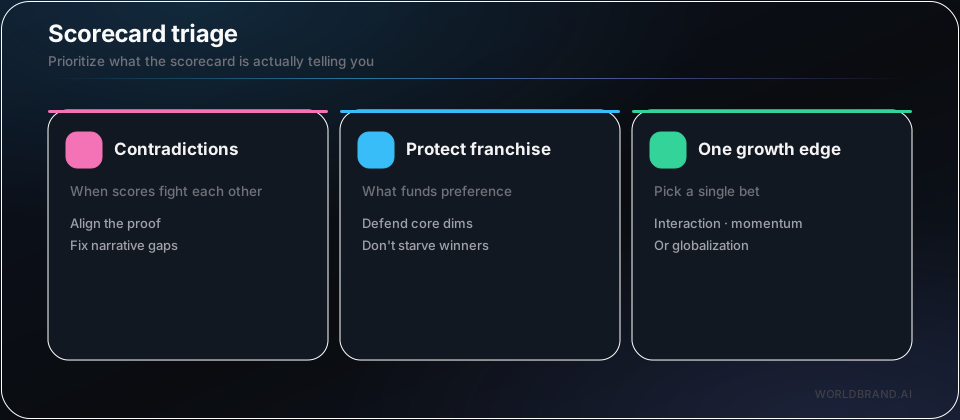
1. Fix contradictions that confuse markets
If leadership is high but interaction is poor, or momentum is high but stability is fragile, you have a narrative risk. Buyers and models both struggle with contradiction. Align proof: what you claim in Brand Hub summaries, wiki-style facts, and campaigns should not fight the scorecard.
2. Protect the franchise dimensions
Whatever currently funds pricing power and preference—often leadership + stability—deserves maintenance budget even when the exciting gap is elsewhere.
3. Pick one growth edge for the next two quarters
Choose one of: interaction, momentum, or globalization (depending on strategy). Multi-front "fix everything" programs dilute ownership.
4. Treat industry profile as context, not as a moral grade
Industry nature explains how hard certain moves are. It should change your playbook, not your self-esteem.
How to use the AI deep-dive without outsourcing judgment
BrandSight's AI deep-dive and recommendations are grounded in scores and peer context. Use them like a sharp analyst memo:
- Accept concrete peer gaps you can verify
- Challenge any recommendation that ignores commercial constraints
- Translate each theme into an owner, a metric, and a date
A good operating rule: every accepted recommendation becomes a row in a working backlog—not a paragraph in a slide that dies after QBR.
Pair BrandSight with the rest of WorldBrand.ai
BrandSight answers "how is the brand built?" Other products answer adjacent questions:
- BrandValue — how markets price the equity over time
- BrandAEO — how answer engines currently narrate you
- BrandWiki / Hub — whether the public factual spine is clean enough to support both humans and models
- BrandAI — drafting briefs and exploring scenarios from the same intelligence stack
The scorecard is the structural X-ray. The Hub is the exam room. AEO is the reputation channel you cannot see in a classic brand tracker alone.
Structural gaps often explain AI framing: weak globalization shows up as local-only shortlists; fragile stability shows up as "risky" or "legacy" adjectives even when ads are loud. Read BrandSight beside AEO, not instead of it.
A 45-minute reading ritual
- Write the one-sentence profile shape.
- List top two strengths and top two gaps vs peers.
- Skim AI deep-dive for mechanisms, not adjectives.
- Choose one gap for a 90-day program; assign a DRI.
- Schedule a re-read after the next data refresh—not after the next campaign anecdote.
Bring the ritual into quarterly planning: BrandSight shape informs whether you defend, accelerate, or repair—especially when paired with BrandValue trends.
Bottom line
BrandSight is not a trophy. It is a diagnostic. Read it for shape, triage for contradictions, invest in one edge, and keep franchise dimensions healthy. Then connect the diagnosis to value, AI visibility, and public facts—so the brand you measure is the brand the market (and the machines) can actually find.
FAQ
What should you fix first on a BrandSight scorecard?
Contradictions that confuse markets—dimensions that fight each other with weak or conflicting proof.
Should every low score become a campaign?
No. Protect franchise dimensions that fund preference, then pick one growth edge for the next two quarters.
How does BrandSight connect to AEO work?
Structural gaps often explain why answer engines frame you as expensive, local-only, or incomplete—even when ads are loud.